
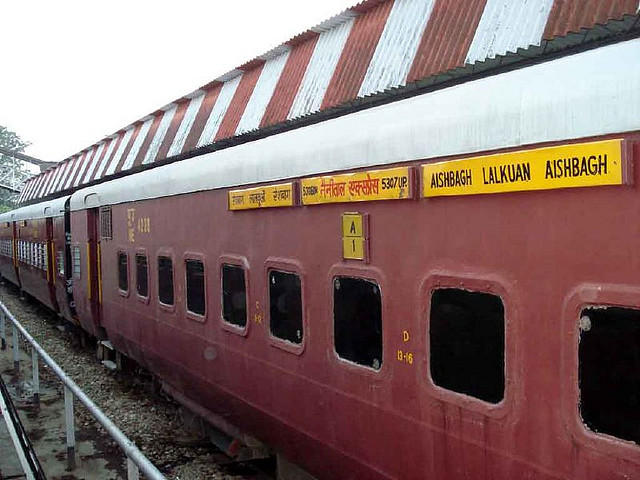
The other day, a friend of mine was searching for an overnight train from Lucknow to Haldwani and back. While the Bagh Express certainly fits the bill, securing a berth is nearly impossible due to the heavy rush. The only viable alternative is the Lucknow–Kathgodam Express. However, there is a catch: it departs Lucknow late at night on only five days a week, and, perhaps more inconveniently, the return journey is a daytime service.
Soon, our discussion veered towards the extremely convenient, good old metre gauge Nainital Express running between Lucknow and Kathgodam, an overnight service in both directions. We had once taken a trip together on this train from Lalkuan to Lucknow following a ‘failed business trip’ to Bhimtal. That failed trip later became the foundation of the firm I am running today. But that is another story.
Metre gauge trains possessed a unique charm. They swayed more, ran slowly, and produced that distinctive rhythmic clickety-clack. The last time I travelled on this train was from Bareilly to Lucknow with my son and one of his friends, probably 15 years ago. We were returning from Chandausi, and there was no room on any other train. By this time, the Nainital Express was running on a curtailed route because of the railways’ Unigauge Project. Consequently, we turned what is usually a four-hour journey on the mainline into an overnight adventure on this train. This was a source of astonishment for both my son and his friend.
I have some of the fondest memories of the Nainital Express. The best one dates back to 1981, when I went to Pantnagar from Lucknow to attend a New Year bash at a Pantnagar University hostel! A friend of a friend and I arrived at Chhoti Line (as Lucknow Junction was then called, and as many Lucknowites still call it, even though the metre gauge is gone) and located our compartment.
Even before the train started, the TTE checked our tickets, and the coach attendant closed the door, something reminiscent of the British Raj. This train was, after all, introduced by the British to ferry officials to the cooler climes of Nainital from the oppressive heat of Lucknow during the summer. The train chugged off right on time.
We woke up in the morning and tried to look outside but could not see anything beyond five to ten metres because of the dense fog. The train was moving slowly through what seemed to be a jungle. About half an hour later, we figured out that the train was somewhere between Mailani and Pilibhit, running late by several hours. We reached Pantnagar in the afternoon instead of the early morning.
About 20 years later, I had to go to Pilibhit on the same train. By this time, the steam engine was gone, and diesel had taken over. The TTE never came to check tickets, and coach attendants were limited to the AC class. The nostalgia had faded. With the conversion of metre gauge into broad gauge, the train was first terminated at Lalkuan. Then, it was diverted to Bareilly when the track between Bhojipura and Lalkuan was converted. Finally, with the Chhoti Line station itself being converted to broad gauge, it ran only between Aishbagh and Bareilly. The curtains finally came down on this legendary train in May 2016.
Photo from internet
Whenever we talk about छोटी लाइन train I recall Kalka Simla train, and passing through 103 tunnels.
The Nainital Express was never just a train.
It was a moving memory, a lifeline stitched with stories, laughter, and quiet tears.